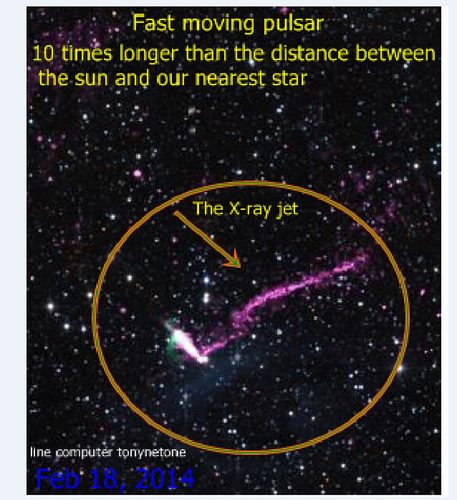

Runaway pulsar has become a topic of interest in the scientific community as it escapes the remnant of its own supernova. This discovery sheds light on the dynamics of stellar evolution.
What is a runaway pulsar?
A runaway pulsar is a highly magnetized, rotating neutron star that emits beams of electromagnetic radiation out of its magnetic poles. When these beams are directed towards Earth, they can be detected as pulses, hence the name “pulsar.” These celestial objects are born from the remnants of massive stars that have undergone supernova explosions. However, unlike typical pulsars that remain within their birth nebulae, runaway pulsars have been ejected at high speeds from their supernova remnants.
The phenomenon occurs when asymmetrical explosions propel the neutron star away from the explosion site. This unique escape trajectory can result in velocities exceeding several hundred kilometers per second. Their high speeds allow runaway pulsars to travel vast distances across the galaxy, sometimes even leaving behind their original stellar nursery.
Runaway pulsars are of significant interest to astronomers because they provide insights into the dynamics of supernova explosions and the evolution of neutron stars. Their study can reveal important information regarding the environments in which they form and the processes that lead to their ejection. Understanding runaway pulsars contributes to the broader knowledge of stellar evolution and the life cycles of massive stars.
The significance of supernova remnants
Supernova remnants are the remnants of massive stars that have exploded at the end of their life cycle. These remnants are crucial to our understanding of cosmic evolution and the lifecycle of stars. When a star goes supernova, it ejects its outer layers into space, creating a nebula that can be observed for thousands of years. The materials released during this explosion contain essential elements that contribute to the formation of new stars, planets, and even life.
One of the most compelling aspects of supernova remnants is their role in the creation of runaway pulsars. These fast-moving neutron stars often result from asymmetric explosions, propelling them away from their birthplace. This phenomenon highlights the intricate dynamics of supernovae and their impact on surrounding cosmic structures.
Furthermore, supernova remnants serve as laboratories for astrophysical research. They allow scientists to study high-energy processes and the behavior of matter under extreme conditions. The interaction between the pulsar and its remnant can provide insights into the physics of neutron stars and the mechanisms driving their formation, paving the way for advancements in our understanding of the universe.
In essence, supernova remnants play a pivotal role not only in the lifecycle of stars but also in the broader tapestry of cosmic evolution.
How runaway pulsars are formed
Runaway pulsars are fascinating astronomical phenomena that emerge from the remnants of supernova explosions. The formation of these celestial objects can be attributed to several critical processes that occur during and after a supernova event.
Typically, when a massive star exhausts its nuclear fuel, it undergoes a catastrophic collapse, resulting in a supernova explosion. This explosion not only ejects the outer layers of the star but can also impart a significant amount of momentum to the newly formed neutron star. As the pulsar is born, it can receive a “kick” due to asymmetrical explosion dynamics, leading to its accelerated movement through the surrounding space.
In addition to the initial kick, interactions with surrounding materials play a crucial role. Factors influencing the direction and speed of the pulsar’s escape include:
- Mass loss: The pulsar’s progenitor may lose considerable mass prior to the explosion, thereby altering gravitational influences.
- Binary systems: If the pulsar was part of a binary system, the dynamics of the companion star can significantly affect the pulsar’s eventual trajectory.
- Supernova asymmetry: Variability in the energy distribution during a supernova can lead to different kick velocities.
As a result, runaway pulsars can travel vast distances from their original supernova remnants, becoming solitary wanderers in the vast cosmos.
Recent discoveries in astrophysics
Recent discoveries in astrophysics have shed light on the fascinating phenomenon of runaway pulsars. These stellar remnants, ejected from their birthplaces, reveal crucial information about the life cycles of stars and the dynamics of supernova remnants. Recent observations have identified several runaway pulsars, providing valuable data on their velocities and trajectories.
One notable discovery involved a pulsar that was observed traveling at speeds exceeding 1,000 kilometers per second. This remarkable velocity challenges previous assumptions about the limits of pulsar movement. Scientists believe that such high-speed escape routes are primarily influenced by interactions with surrounding matter or gravitational forces from nearby stars.
Key findings from these studies include:
- Formation mechanisms: Insights into the mechanisms driving the ejection of runaway pulsars from supernova remnants.
- Velocity patterns: Analysis of how the velocities of these pulsars correlate with their progenitor stars’ mass and the characteristics of their explosive deaths.
- Galactic distribution: Mapping the locations of runaway pulsars can help astronomers understand their role in the evolution of galaxies.
As researchers continue to explore the universe, runaway pulsars remain a focal point in unraveling the mysteries of stellar evolution and cosmic phenomena.
Implications for future research
The discovery of runaway pulsars opens new avenues for research in astrophysics, particularly concerning the life cycles of massive stars and their explosive deaths. Understanding the mechanisms behind the formation of runaway pulsars can shed light on stellar evolution and the dynamics of supernova remnants.
Researchers are now focused on several key implications:
- Stellar Kinematics: The motion of runaway pulsars provides insights into the velocity distributions of stars in our galaxy, enhancing our understanding of stellar interactions and evolution.
- Supernova Mechanisms: By studying the remnants from which these pulsars escape, scientists can refine their models of supernova explosions, particularly concerning the asymmetries that may lead to such high-velocity ejections.
- Cosmic Ray Research: Runaway pulsars contribute to cosmic ray production, and their behavior could help explain the origins and acceleration mechanisms of these high-energy particles.
- Galactic Evolution: The presence of runaway pulsars influences the distribution of matter in the galaxy, impacting star formation and the evolution of galactic structures.
In summary, runaway pulsars represent not just fascinating cosmic objects but also vital clues to understanding the broader universe.
The runaway pulsar has become a subject of fascination for astronomers studying the aftermath of supernova explosions. Understanding the dynamics of a runaway pulsar can provide insights into the conditions that lead to such extraordinary cosmic events.
By tonynetone via Openverse
Sources